


AVaTAR — Asian Literature in the Victorian World


Marginal Activity: Two Rubaiyat Readers
Archive of Victorian Translations from Asia and their Readerships
Asian Literature in the Victorian World
- by Rudabeh Gray
- 29 July 2024
- Next:
AVaTAR: a Global Collection
31 March 2025 - Previous:
Origins of the Collection
21 April 2023
Billy Collins’ poem ‘Marginalia’ details the universal propensity to ‘seize the white perimeter’ of the page ‘as our own’, the propensity, when reading, to reach for a pen or pencil and leave our mark,
if only to show
we did not just laze in an armchair turning pages;
we pressed a thought into the wayside,
planted an impression along the verge.
Collins’ words came to mind whilst looking at early twentieth-century copies of Edward FitzGerald’s Rubaiyat of Omar Khayyam, many of which, to use Collins’ term, were enwreathed with their reader’s annotations.
Collins’ equation of writing in the margin with ‘plant[ing]’ one’s impressions ‘along the verge’ is strangely apt in the case of FitzGerald. For readers such as Winnifred Mary Carruthers and the unknown P. Ross (both of whose copies of FitzGerald’s Rubaiyat – first edition, 1859 – are now in the AVaTAR collection), the commentary planted along the border of the page tends to be cuttings from FitzGerald himself, namely references to the other versions of his poem in existence. FitzGerald published four editions of the Rubaiyat over the span of twenty years, and readers such as Carruthers and Ross directed their annotative scribblings towards the changes made by FitzGerald across these multiple editions. Whether replicating in full a different version of the same quatrain or carefully registering a more minute difference in word choice, these marginalia recall the poem’s preoccupation with the dissolution of matter and its reappearance in a form which yet bears traces of its origin. This involvement of matter with past forms and future buddings is encapsulated in quatrain XIX of FitzGerald’s first edition:
And this delightful Herb whose tender Green
Fledges the River’s Lip on which we lean —
Ah, lean upon it lightly! for who knows
From what once lovely Lip it springs unseen!
The description of decomposed bodies (lovely Lip) providing fodder for new life (delightful Herb) is a recurrent one in the Rubaiyat. In the poem, the natural world finds itself ceaselessly poised on the brink of dissolution as matter is constantly recycled, pushed and pulled between the extremes of shekuftan (blooming) and pazhmurdan (dying). In a not dissimilar vein, the readerly impulse to place FitzGerald’s versions adjacent to one another, as exhibited by Ross and Carruthers, recalls the text’s preoccupation with continual rebirth. Readerly commentary creates a kinetic dynamic, the marginal word overlapping with, and lapping over, the printed word.
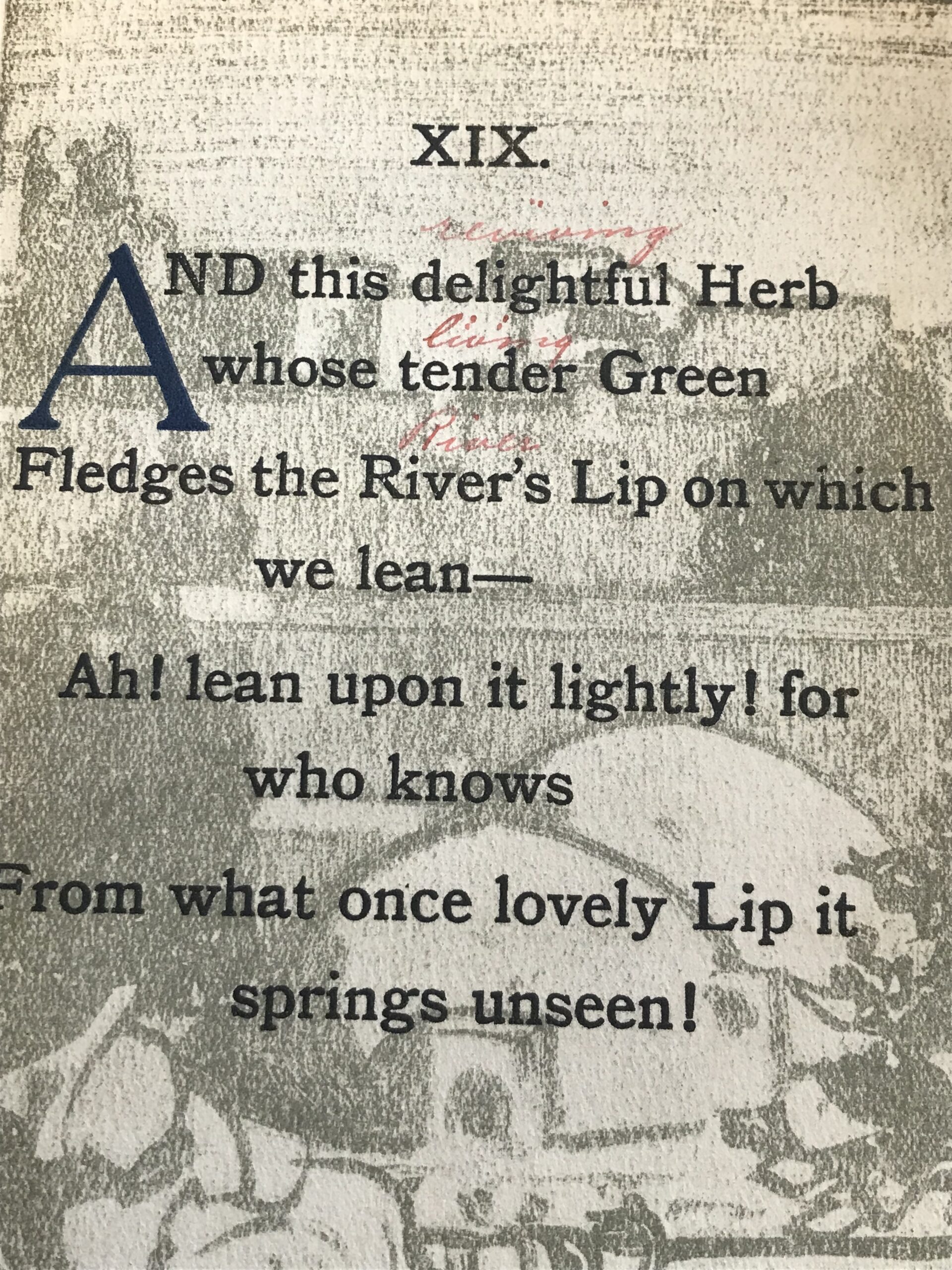
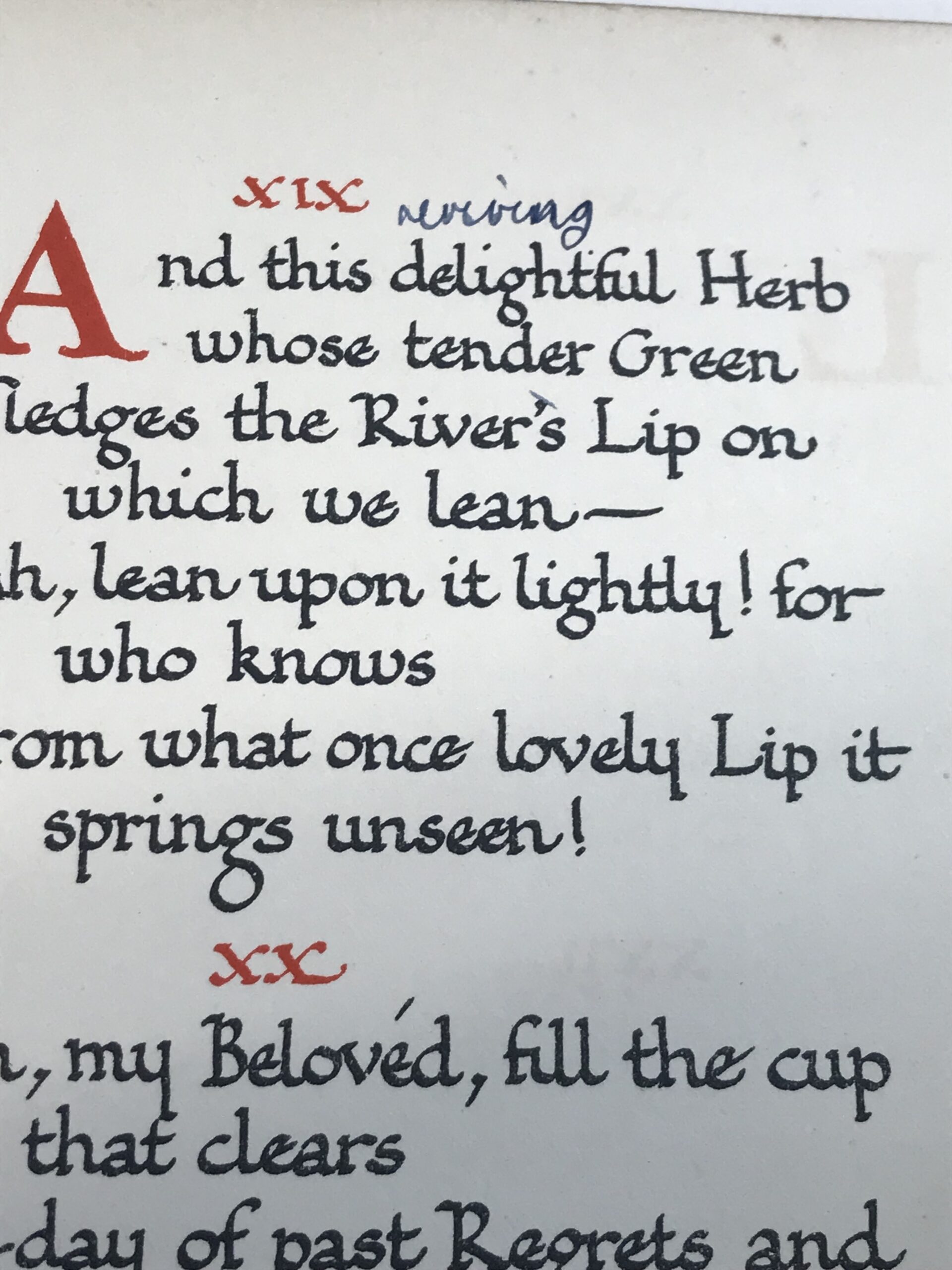
Pen in hand, Carruthers (left) and Ross (right) pick up on the semantic variation in the above quatrain, both noting the shift from ‘delightful’ to ‘reviving’ in later versions of this quatrain: ‘And this delightful/reviving Herb’ (see figures above). Carruthers goes further than Ross, glossing the adjective ‘tender’ with its parallel, ‘living’: ‘whose tender/living Green’. Whilst FitzGerald’s second edition amended ‘tender’ for living’ and retained ‘delightful’, his third and fourth editions reverted back to ‘tender’ and replaced ‘delightful’ with ‘reviving’. Via neat annotations, Carruthers and Ross bring the wording of later editions back to nestle alongside the original phrasing, allowing the ebb and flow of the editorial process to momentarily coalesce. Carruthers’ writing, effected almost entirely in red ink, blossoms on the page, acts of editing laying bare the edits of the author.
Carruthers and Ross demonstrate a reading style that is rather more active than ‘just laz[ing] in an armchair turning pages’—a style that appears, based on other Rubaiyats in the AVaTAR collection, to have been the rule, rather than the exception, for FitzGerald’s readers.
Comments:
Comments on “Marginal Activity: Two Rubaiyat Readers” (0)